
 Last week Dr Euan Wielewski travelled to cold and snowy Ithaca with PhD students Kayleigh Nelson and Chris Triantafyllou to carry out experiments at the Cornell High Energy Synchrotron Source (CHESS). Following up on Kayleigh's previous work, her experiments focused on the material's behaviour during strain jumps and Chris' experiments compared the fatigue behaviour with and without dwell episodes. These experiments marked the start of investigations on unidirectionally-rolled Ti64 for Chris and on cross-rolled Ti64 for Kayleigh. The huge advantage of working in-situ at a synchrotron is that we were able to capture lattice strains through powder (x-ray) diffraction with an acquisition frequency of up to 10Hz. This is not only useful in providing a deeper understanding of the mechanical response at the grain level, but also generates information that can be used to significantly improve our computational models. Both Kayleigh and Chris will be resuming work using FEpX later next year, also developed at Cornell University. Many thanks go to our collaborators from CHESS, Darren Pagan and Peter Ko, as well as Glenhead Engineering for their fantastic work with our millimetre-thick specimens!
MRG PhD students Kayleigh Nelson and Chris Triantafyllou attended the Aerospace Symposium 2017 organised by the University of Glasgow and had the chance to present two posters on their research. The event which attracted over 80 delegates from industry and academia was focused on manufacturing for growth and featured interesting presentations from Airbus COO, Tom Williams, BAE Systems Head of Manufacturing and Materials Engineering, Andrew Schofield, and more.  Kayleigh's work focuses on the deformation of titanium alloys and how this differs between single- and dual-phase alloys. Chris has previously worked on cold-dwell fatigue and is currently investigation the effect of cross-rolling on notched fatigue behaviour. You can find out more about both projects here!
 The Materials Research Group hosted a 2-day workshop at the University of Glasgow on 'Modelling the Micromechanics of Polycrystalline Materials'. The workshop took place on the 7-8th April 2016 and was sponsored by the Leverhulme Trust, the EPSRC and the University of Glasgow. The goal of the workshop was to introduce researchers to the crystal plasticity finite element software package, FEpX, and a number of tools, including the virtual polycrystal generation package, Neper, and the crystal orientation calculation toolbox, ODFPF, that together constitute a complete capability for modelling polycrystalline solids. The workshop was aimed at young researchers such as graduate students and post-doctoral associates who would like to integrate crystal-scale finite element modelling into their own research projects. Workshop attendees came from University of Oxford, Imperial College London, University of Manchester, University of Birmingham and University of Strathclyde.  The workshop consisted of several lectures as well as practical modelling experience, with the attendees executing FEpX simulations on a High Performance Computing (HPC) cluster at the University of Glasgow.
The workshop was led by Prof. Paul Dawson (Cornell University, USA), Dr Romain Quey ( Ecole des Mines de Saint-Etienne, France) and Matt Kasemer (Cornell University, USA). More information about the software packages used in the workshop can be found here:  Euan and Kayleigh attended the International Workshop on 'Mechanistic Behaviour of HCP Alloys 2016', which was held at Pembroke College, Oxford, UK.
This workshop drew together industrial and academic experts from a variety of disciplines, including materials science and engineering, mechanical engineering, non destructive testing, and high rate deformation. Discussions focused on microstructure-performance property relationships and their impact on engineering components in industries such as aerospace, nuclear power, and transport. Read more about it here. Euan presented his recent work on determining Ti-6Al-4V single crystal material parameters using a discrete spherical harmonic analysis of lattice strain pole figures from in situ mechanical testing at the Cornell High Energy Synchrotron Source and crystal plasticity finite element simulations. Euan also chaired a session on the high strain rate behaviour of HCP materials. 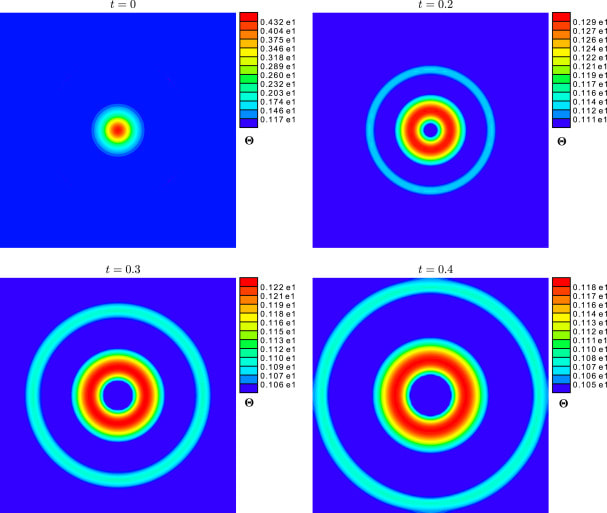 An article co-authored by Dr Andrew McBride, Mebratu Fenta & Daya Reddy has been published in Computer Methods in Applied Mechanics and Engineering.
An efficient time-stepping algorithm is proposed based on operator-splitting and the space-time discontinuous Galerkin finite element method for problems in the non-classical theory of thermoelasticity. The non-classical theory incorporates three models: the classical theory based on Fourier’s law of heat conduction resulting in a hyperbolic-parabolic coupled system, a non-classical theory of a fully-hyperbolic extension, and a combination of the two. The general problem is split into two contractive sub-problems, namely the mechanical phase and the thermal phase. Each sub-problem is discretized using the space-time dis- continuous Galerkin finite element method. The sub-problems are stable which then leads to unconditional stability of the global product algorithm. A number of numerical examples are presented to demonstrate the performance and capability of the method. You can access the full text via Science Direct by following the link below. 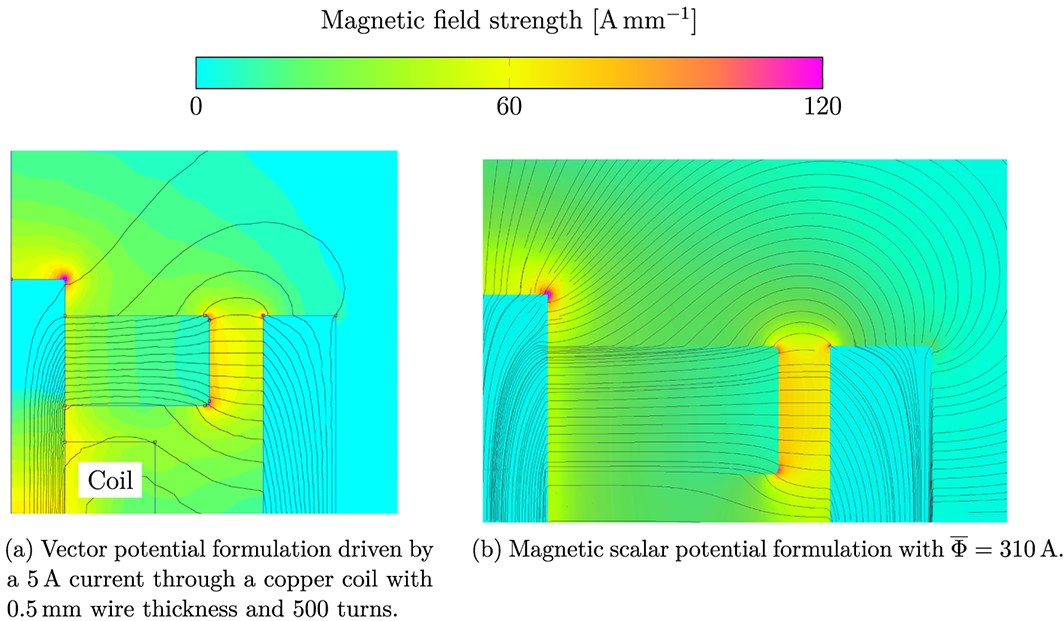 An article co-authored by Dr Andrew McBride and Jean-Paul Pelteret, Denis Davydov, Andrew McBride, Duc Khoi Vu & Paul Steinmann has been published in the International Journal for Numerical Methods in Engineering.
In this work a mixed variational formulation to simulate quasi-incompressible electro- or magneto-active polymers immersed in the surrounding free space is presented. A novel domain decomposition is used to disconnect the primary coupled problem and the arbitrary free space mesh update problem. Exploiting this decomposition we describe a block iterative approach to solving the linearised multiphysics problem, and a physically and geometrically based, three-parameter method to update the free space mesh. Several application-driven example problems are implemented to demonstrate the robustness of the mixed formulation for both electro-elastic and magneto-elastic problems involving both finite deformations and quasi-incompressible media. You can access the full text via the Wiley Online Library by following the link below. |
Archives
December 2025
Categories |


 RSS Feed
Research
|
About us
|
|